
Adaptation Plan: Off-Grid Resilience Against California Power Outages
Eric Chi Wang Tsang
May 14, 2026
1. Introduction
Subject Context
This adaptation plan focuses on residential off grid microgrids to provide resilience against California power outages. A residential microgrid is a localized power generation and storage system. It normally operates connected to the traditional utility grid but it has the technological capacity to automatically disconnect and function entirely independently during an outage (Clean Coalition, 2021).
Why it Matters
This adaptation matters urgently because extended power losses pose a severe threat to human life and property. When the centralized grid fails during extreme heatwaves residents lose the ability to cool their homes which leads to heat stroke and death particularly among the elderly and vulnerable populations. During wildfire evacuations power loss disables communication networks and water pumps which severely compromises public safety.
Geographic Range
The geographic range for this plan is the entire state of California but it places specific emphasis on highly vulnerable zones. These zones include the Wildland Urban Interface regions such as the Sierra Nevada foothills and Southern California chaparral areas (Greenberg et al., 2024; Kocher & Butsic, 2017). It also includes dense urban heat islands in the Central Valley and the Los Angeles basin where extreme heat heavily strains the electrical grid.
Background Information
To understand this adaptation one must understand residential building science. Standard California homes act as leaky buckets. They have poor thermal mass and inadequate insulation. Without constant electrical power to run air conditioning these homes lose safe interior temperatures rapidly and equalize with the dangerous outside heat (Hao et al., 2022).
Stakeholders and Collaborators
- Residential homeowners and neighborhood associations
- Utility companies and grid operators
- City councils and state policymakers
- Solar contractors and battery storage manufacturers
- Urban planners and community advocacy groups
2. Goals Objectives and Drivers
Management Goal
The overarching goal of this adaptation plan is to achieve passive survivability and energy resilience for vulnerable California residential communities by transitioning them away from fragile centralized grids to decentralized off grid capable microgrids.
Objectives
1. Implement deep energy retrofits including comprehensive air sealing and dense packed insulation in at least 500 highly vulnerable homes within the Wildland Urban Interface by 2030.
2. Equip 50 percent of retrofitted homes with right sized solar photovoltaic arrays and battery energy storage systems featuring islanding inverters by 2035.
3. Partner with local municipalities to introduce and adopt building code amendments by 2028 that mandate off grid solar and battery storage capabilities for all new residential construction.
Major Drivers of Change
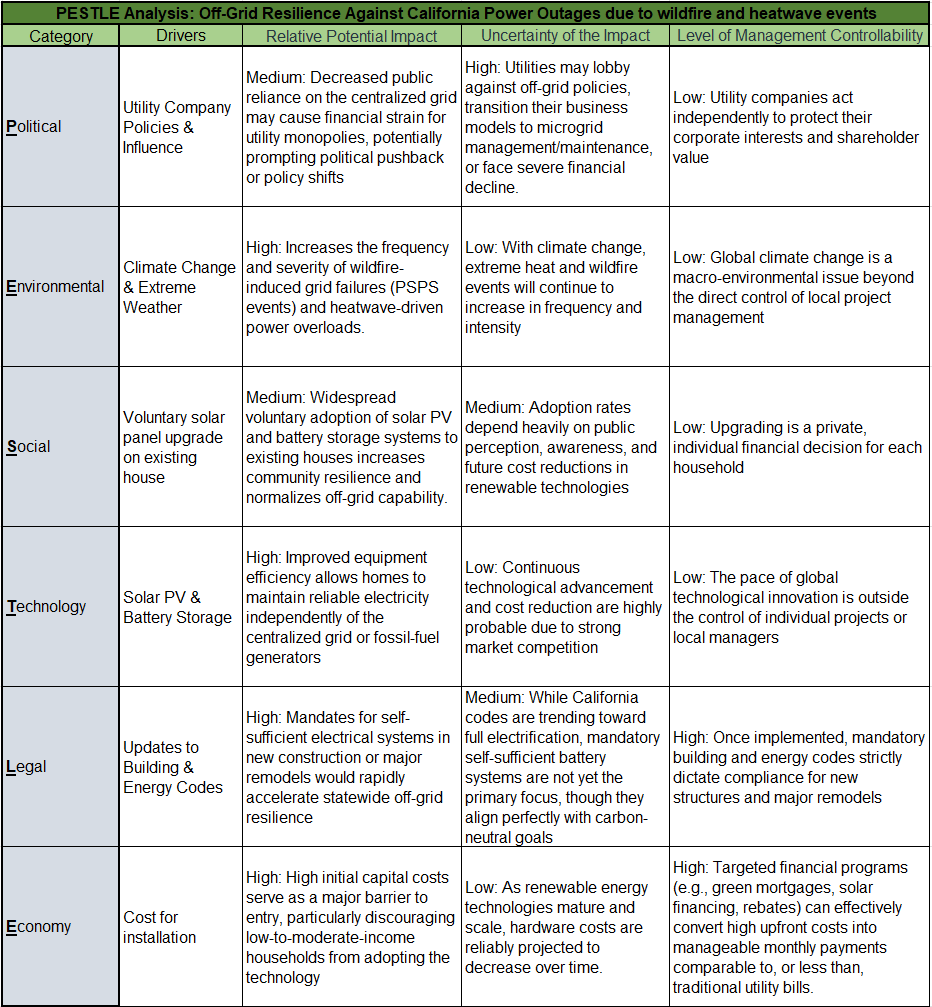
The following PESTLE analysis details the major drivers affecting this adaptation plan.
3. Climate Scenario or Projections
Climate Change Context
This plan prepares for climate change scenarios characterized by compounding extreme weather events in California. Projections indicate a severe increase in both the frequency and intensity of summer heatwaves (Stone, 2026). Furthermore climate models project prolonged drought conditions leading to extreme and unpredictable wildfire behavior specifically in the Wildland Urban Interface.
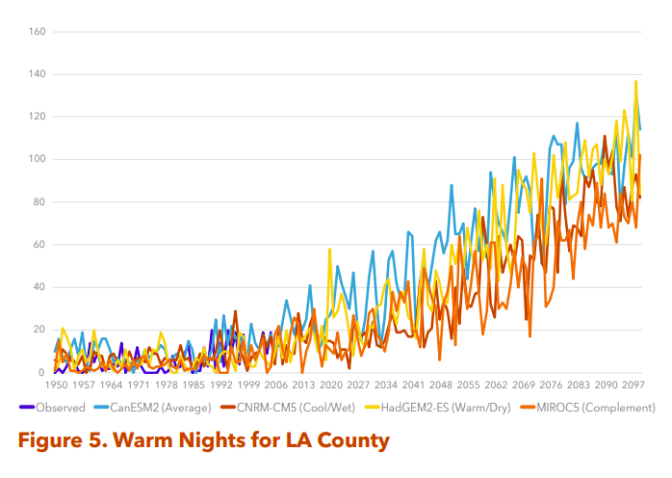
Night temperature graph in LA County (Stone, 2026)
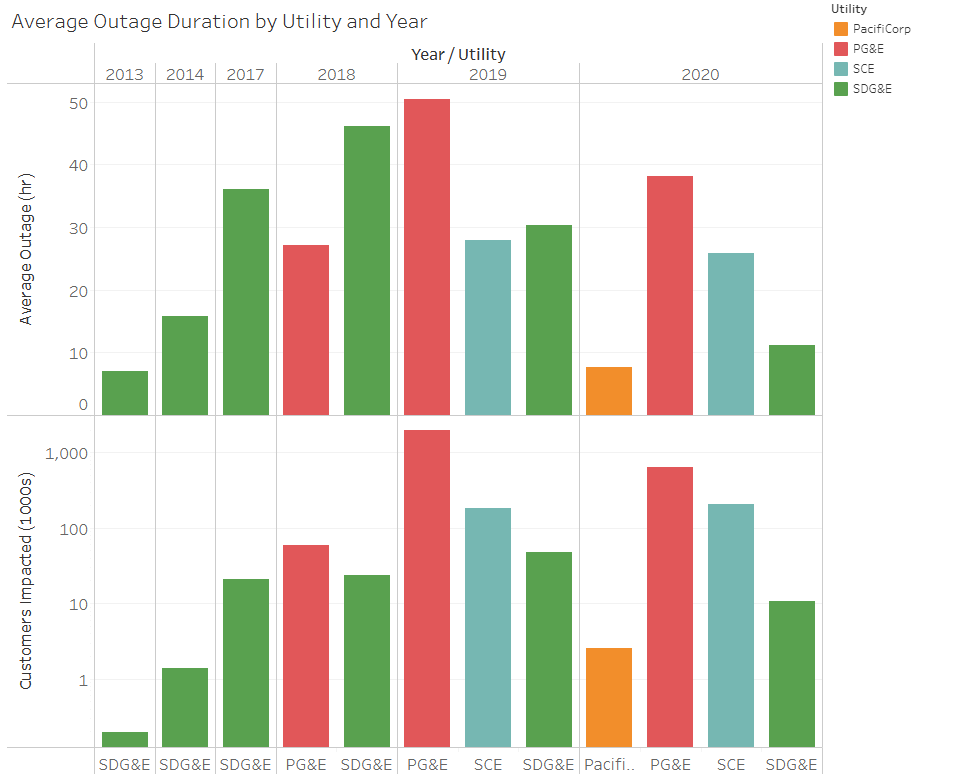
Average Outage Duration by Utility and Year (WP, 2021)
Secondary Impacts
These weather extremes directly translate into severe secondary impacts on human infrastructure (Zamuda et al., 2019). Extreme heat creates massive statewide demand for air conditioning which causes grid overloads and planned rolling blackouts. Simultaneously high wind and dry conditions force utility companies to initiate Public Safety Power Shutoffs to prevent their own transmission lines from sparking wildfires (California Public Utilities Commission, 2023; WP, 2021).
4. Vulnerability Assessment
Spatial Extent and Refugia
The spatial extent covers California focusing on the Wildland Urban Interface and urban cores. Within this area climate refugia exist. Coastal enclaves protected by the marine layer experience natural cooling and avoid extreme 100-degree heatwaves. Additionally neighborhoods with entirely underground power infrastructure act as refugia because they are insulated from wind driven power shutoffs.
Exposure
Exposure is the compounding threat of extreme heatwaves and approaching wildfires. The direct exposure is physical heat and smoke while the secondary exposure is the systemic failure of the centralized electrical grid exactly when residents need it most for cooling and emergency communication.
Sensitivity
The sensitivity of the uninsulated California housing stock is profound. Older homes built before modern energy codes quickly become dangerously hot without grid power. Human populations requiring refrigerated medications or constant cooling possess extreme physical sensitivity to extended power outages.
Adaptive Capacity
Adaptive capacity is currently low but this plan increases it through aDeep Energy Retrofits approach. By heavily insulating the home first the structure acts as a thermal battery (Erba & Barbieri, 2022). This drastically lowers energy demand making it easy for a solar and battery microgrid to power the home indefinitely.
Time Scale Vulnerability
| Time Scale | Estimated Vulnerability | Reasoning |
|---|---|---|
| Shorter Term to 2030 | High | Low public adoption and prohibitive upfront costs leave millions dependent on the aging grid. |
| Longer Term to 2050 | Medium to Low | High adoption driven by technological cost reductions and mandatory building code updates will create a highly resilient housing sector |
Non Climate Stressors
The primary non climate stressors are economic barriers and political resistance. The high upfront capital cost of deep energy retrofits and battery systems ensures that only wealthy households can currently afford safety. Politically utility companies lobby against decentralized power because it threatens their monopoly and financial bottom line.
5. Identify Possible Adaptation Actions
Infrastructure Actions
- Deep energy retrofits: Implement comprehensive air sealing and insulation to reduce baseline residential cooling demand.
- Solar and battery installations: Install rooftop solar arrays and battery storage systems with islanding inverters for off grid power generation.
- Transition to all electric appliances: Replace gas furnaces with electric heat pumps to ensure the home can run entirely on solar power during an outage.
Policy and Financial Actions
- Building code mandates: Update local regulations to require self sufficient energy storage capabilities for all new residential construction (California Energy Commission, 2022).
- Streamlined permitting: Implement expedited permit processes and waive administrative fees for homeowners voluntarily installing microgrids.
- Targeted financial subsidy programs: Develop state backed tax rebates and low interest loans to offset high upfront capital costs for low income households (California Public Utilities Commission, 2024).
Community Actions
- Pilot demonstration programs: Launch localized neighborhood pilots in high risk zones to showcase microgrid effectiveness during simulated outages.
- Localized resilience hubs: Equip centralized community buildings with large scale commercial microgrids to serve as emergency cooling centers.
6. Evaluate and Select Adaptation Actions
Compare and Contrast
When comparing these actions theDeep Energy Retrofits and targeted financial subsidies must happen before widespread solar adoption is viable. Attempting to install solar and batteries on an uninsulated leaky home requires massive expensive battery banks. Insulating the home first shrinks the required battery size which makes the entire system affordable.
Selected Priority Actions
| Action | Expected Effectiveness | Estimated Stability | Key Uncertainties |
|---|---|---|---|
| Deep Energy Retrofits | High: Drastically reduces cooling demand | 50 plus years | Contractor availability |
| Solar and Battery Microgrids | High: Provides independent power | 15 to 20 years | Supply chain shortages |
| Financial Subsidy Programs | High: Removes economic barriers | Dependent on state budgets | Future political shifts |
| Municipal Code Mandates | High: Forces systemic scaling | Permanent once enacted | Lobbying pushback |
Addressing Uncertainty
A key uncertainty in this plan is aggressive utility company pushback. Utility companies may attempt to restrict or financially penalize individual microgrids to protect their revenue. I plan to deal with this uncertainty by focusing my efforts on local municipal building codes rather than relying on utility company cooperation. City councils have the authority to mandate building safety standards independently of utility monopolies.
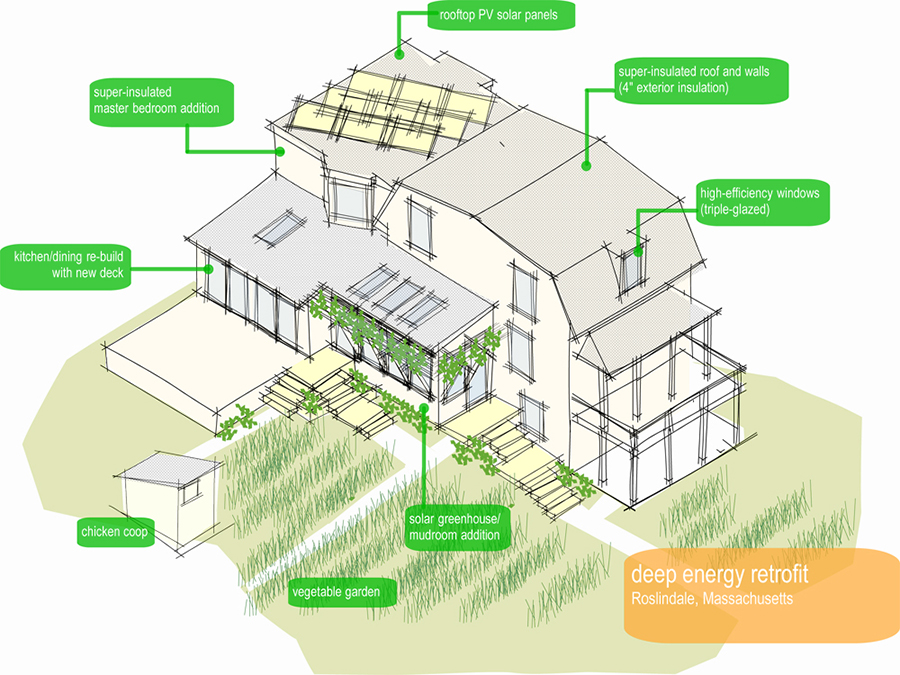
Deep Energy Retrofit Diagram (Boehm Architecture, n.d.)
7. Implementation of Priority Adaptation Actions
Rollout Strategy
I will implement these priority actions by first working with city councils to launch the pilot demonstration program. Once the pilot proves successful I will use the local data to lobby the city council to adopt the updated building codes mandating microgrids for new construction. Concurrently I will work with state grant programs to secure subsidy funding for existing homeowners.
Obstacles
- High initial municipal funding is required to launch the pilot programs and rebate structures.
- Political lobbying from natural gas companies will aggressively oppose the transition to all electric appliances.
Opportunities
- Current federal climate funding and tax credits can be leveraged directly by homeowners to offset installation costs.
- Widespread microgrid installation presents a massive opportunity for local green job creation in the construction and electrical sectors.
8. Develop a Monitoring Plan
Assessment Strategy
I will assess progress toward the adaptation goals through an annual review process. This review will evaluate public adoption rates construction data and policy implementation across targeted municipalities to ensure the transition to off grid resilience is staying on schedule.
Key Metrics
- Number of deep energy retrofits completed in designated high risk zones year over year.
- Percentage of new residential building permits that successfully incorporate islanding solar and battery microgrids.
- Number of local municipalities successfully adopting the updated building codes.
- Post outage survey results and temperature data from pilot program participants.
9. Other Considerations
Embracing Uncertainty
There are global supply chain uncertainties regarding the raw materials needed for mass battery production such as lithium and cobalt. Global market shifts could temporarily raise the price of battery storage which would slow down the implementation timeline. We must embrace this uncertainty and continue pushing theDeep Energy Retrofits strategy which requires cheap abundant materials like cellulose and mineral wool.
Collaborators and Boundary Spanning
Effective implementation requires boundary spanning leadership. I will act as a liaison to bridge the communication gaps between private homeowners city planners and commercial solar contractors. Translating the technical engineering needs into actionable public policy is essential for the adaptation plan to succeed.
Climate Mitigation Overlap
This adaptation plan actively incorporates climate mitigation. By eliminating the need for fossil fuel backup generators and replacing gas appliances with electric alternatives powered by the sun this plan directly reduces greenhouse gas emissions. Adapting to the climate crisis and mitigating its root cause happen simultaneously in this model.
References
Boehm Architecture. (n.d.). Deep energy retrofit. Retrieved May 10, 2026, from https://www.boehmarchitecture.com/portfolio_page/deep-energy-retrofit/
California Energy Commission. (2022). 2022 building energy efficiency standards for residential and nonresidential buildings (Title 24, Part 6). State of California. https://www.energy.ca.gov/programs-and-topics/programs/building-energy-efficiency-standards/2022-building-energy-efficiency
California Public Utilities Commission. (2023). Public safety power shutoffs (PSPS). State of California. https://www.cpuc.ca.gov/consumer-support/psps
California Public Utilities Commission. (2024). Self-generation incentive program (SGIP). State of California. https://www.cpuc.ca.gov/sgip/
Clean Coalition. (2021). Community microgrids. https://clean-coalition.org/community-microgrids/
Erba, S., & Barbieri, A. (2022). Retrofitting buildings into thermal batteries for demand-side flexibility and thermal safety during power outages in winter. Energies, 15(12), 4405. https://doi.org/10.3390/en15124405
Greenberg, M., Angelo, H., Losada, E., & Wilmers, C. C. (2024). Relational geographies of urban unsustainability: The entanglement of California’s housing crisis with WUI growth and climate change. Proceedings of the National Academy of Sciences, 121. https://doi.org/10.1073/pnas.2310080121
Hao, L., Herrera-Avellanosa, D., Del Pero, C., & Troi, A. (2022). Overheating risks and adaptation strategies of energy retrofitted historic buildings under the impact of climate change: Case studies in alpine region. Applied Sciences, 12, 7162. https://doi.org/10.3390/app12147162
Kocher, S., & Butsic, V. (2017). Governance of land use planning to reduce fire risk to homes mediterranean France and California. Land, 6, 24. https://doi.org/10.3390/land6020024
Mann, M. L., Berck, P., Moritz, M. A., Batllori, E., Gately, C., & Cameron, D. R. (2014). Modeling residential development in California from 2000 to 2050: Integrating wildfire risk, wildland and agricultural encroachment. Land Use Policy, 41, 438-452. https://doi.org/10.1016/j.landusepol.2014.06.020
Stone, E. (2026, February 3). Southern California is getting hotter. LA County now has a heat action plan. LAist. https://laist.com/news/climate-environment/southern-california-is-getting-hotter-la-county-now-has-a-heat-action-plan
WP, S. (2021, March 19). Preventing wildfires with power outages: The growing impacts of California’s public safety power shutoffs. PSE Healthy Energy. https://www.psehealthyenergy.org/preventing-wildfires-with-power-outages-the-growing-impacts-of-californias-public-safety-power-shutoffs/
Zamuda, C. D., Larsen, P. H., Collins, M. T., Bieler, S., Schellenberg, J., & Hees, S. (2019). Monetization methods for evaluating investments in electricity system resilience to extreme weather and climate change. The Electricity Journal, 32, 106641. https://doi.org/10.1016/j.tej.2019.106641