
The Grown Envelope: Microstructural Engineering of Bio-composites for Carbon-Negative Architecture
Eric Chi Wang Tsang
May 6, 2026
Introduction
Traditional construction relies heavily on high embodied energy materials like steel, concrete, and standard silica glass (10 - page #48-49). These materials create a severe structural paradox for modern architecture: materials dense enough to carry heavy loads inherently possess high thermal conductivity. Because of this physical reality, these structures continually leak operational energy throughout the building lifespan (10 - page #71-75). Consequently, this inefficiency forces architects to rely on massive, energy intensive mechanical systems to regulate interior temperatures, continuing a cycle of carbon emission long after construction is complete (10 - page #45-48).
Achieving a truly carbon negative design requires the industry to abandon extractive, multi layered material assemblies. Instead, we must shift toward regenerative cultivation, utilizing living biological phases to physically grow architecture from the ground up (5 - page #191-217). This is made possible through microstructural engineering. By altering growth parameters during the cultivation phase, engineers can determine exact material performance without mining new components or relying on petrochemical manufacturing processes (7 - page #131-141).
The primary objective of this thesis is to investigate the viability of replacing mined materials with cultivated biocomposites. Specifically, this research introduces two primary case materials: functionally graded mycelium and transparent wood. When utilized correctly, these materials can replace high embodied energy conventional materials to achieve net positive thermal and structural performance in self-supporting envelopes, provided specific mitigation strategies address their inherent vulnerabilities.
Material Mapping and The Structural Parameter
Standard wall construction relies on completely separate layers for structure, such as wood or steel studs, and insulation, such as fiberglass or spray foam. This research proposes a fundamentally different model: replacing the entire stud and batt assembly with a single, continuous block of structural mycelium. To accomplish this, the design relies on the concept of functionally graded material, focusing first on growing the outer layer of the block to be highly dense (3 - page #10-12).
Data regarding compressive strength demonstrates that this biological matrix behaves predictably based on the chosen lignocellulosic substrate, with different agricultural wastes yielding different stiffness levels (3 - page #8-10). Despite this adaptability, engineers must acknowledge the material primary weakness: pure mycelium has a significantly lower tensile strength compared to steel or timber (4 - page #1-2).
Reference: https://doi.org/10.1371/journal.pone.0213954.g004
Fortunately, structural viability can be engineered to overcome this low tensile strength by introducing natural reinforcements into the mycelium matrix during the growth phase. Specifically, utilizing bacterial cellulose or natural flax fibers acts as a highly effective reinforcement mechanism. The high tensile strength of the substrate provides a rigid scaffolding for the fungal network, drastically increasing the load bearing capacity of the dense outer envelope (4 - page #9-10).
The transparent portions of the envelope also require total material reinvention. Standard silica glass is highly brittle and prone to failure under stress. Because of its fragility and weight, traditional windows remain a significant weak link in overall envelope structural integrity. To resolve this, delignified transparent wood impregnated with ecofriendly polymers serves as a highly anisotropic structural alternative. Retaining the natural cellular scaffolding of the original wood gives the composite a fracture toughness orders of magnitude higher than standard glass, yielding a safer, shatter resistant envelope capable of handling dynamic loads (14 - page #5).
The Thermal Insulation Parameter
Shifting focus from the dense outer layer, the interior core of the functionally graded block is cultivated to be highly porous. Under compression, the morphology of this fungal matrix behaves identically to an open cell foam (9 - page #1-2).
This structure is highly efficient because the porous network traps stagnant air within the wall assembly (9 - page #7-10). This creates a continuous thermal barrier that entirely eliminates the thermal bridging caused by traditional structural studs. When tested, its thermodynamic efficiency and acoustic absorption properties directly rival, and in some cases exceed, traditional petrochemical foams (6 - page #8-9).
Furthermore, specific fabrication factors and the choice of agricultural waste directly drive ultimate thermodynamic efficiency (1 - page #2-5). For example, utilizing highly porous agricultural waste like hemp or straw as a growth substrate allows architects to tune the material for maximum moisture retention and thermal resistance simultaneously (3 - page #10) (4 - page #9-10).
Reintroducing traditional glazing reveals deep thermal failures, as conventional windows act as thermal sieves responsible for significant operational energy loss (12 - page #1-2). Transparent wood composites solve this issue while maintaining performance. Optical data confirms that transparent wood composites transmit approximately 85- 95 percent of visible light, maintaining excellent daylighting parameters for interior spaces (11 - page #1). More importantly, the polymer impregnated cellular structure maintains a significantly lower U factor and thermal conductivity than standard multipane glass. Utilizing this material drastically reduces winter heat loss and summer solar heat gain, effectively shifting the envelope from an energy liability to a net positive asset (12 - page #6-7).
Architectural Precedents and Hypothesis Project
Several prominent case studies prove that parameter optimization works outside of a laboratory. The MycoTree Project proves extreme tensile strength is unnecessary if informed structural engineering is used. By utilizing compression only architectural geometries, engineers can safely distribute load forces through low strength cultivated biomaterials without risking collapse (7 - page #135-140).
The HyFi Tower provides another layer of validation, demonstrating real world scalability and outdoor weather durability when mycelium bricks are stacked into a massive, self supporting pavilion (2 - website). Looking to the future, NASA Off Planet Architecture research acts as a proof of concept for extreme environments; growing surface structures on Mars validates the extreme structural efficiency, high thermal resistance, and low mass of these biocomposites (13 - website).
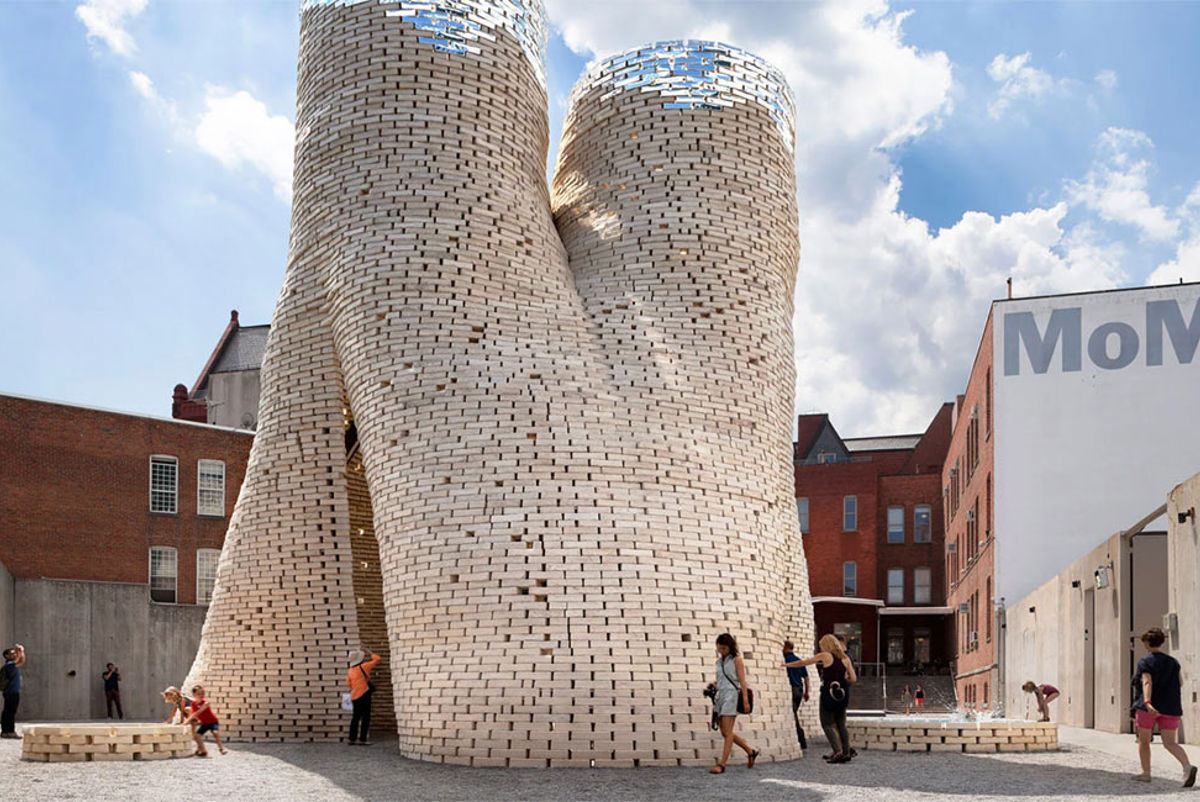
Reference: https://www.arup.com/en-us/news/hy-fi-reinvents-the-brick/
Building upon these precedents, a theoretical residential envelope design can be generated. Driven entirely by structural and thermal functional parameters, the model utilizes a continuous, functionally graded mycelium wall transitioning from a dense structural exterior to an insulating interior foam. It is punctuated exclusively by transparent wood windows to prove a net positive thermal boundary is achievable without mined materials.
Implementation Challenges
Transitioning this theoretical model into the mainstream market faces massive hurdles. Current building codes lack classification standards and testing protocols for grown or cultivated materials. Consequently, legal challenges arise regarding liability and warranty concerns associated with the long term structural integrity of non traditional materials. Economic challenges also restrict growth due to high initial capital requirements for scaling bio fabrication infrastructure, despite relatively low raw material costs.
Social perception creates hurdles regarding the cultural acceptance of living walls, and users often prefer perfectly clear glazing over translucent transparent wood. Environmental concerns also dictate that strict ecological management is required to ensure introduced fungal spores or bacterial strains do not disrupt local ecosystems.
However, the greatest technological threat remains sustaining long term structural and thermal integrity, requiring aggressive moisture management. Fabrication factors deeply influence material water related properties (1 - page #2-5). Without robust protective measures, mycelium based and cotton plant composites face the severe threat of premature biodegradation and structural waterlogging (8 - page #5).
Strategies for Implementation and Mitigation
To overcome the lack of classification standards, the industry must transition to performance based building codes. Developing standardized accelerated weathering and compressive load testing protocols for biomaterials will provide the empirical data necessary to satisfy strict insurance and liability frameworks.
Moisture degradation must be aggressively addressed without compromising the end of life composability of the envelope (8 - page ##6-8). Because synthetic petrochemical coatings must be completely avoided, the solution involves applying natural, water repellent bio coatings. Instead, the architectural solution involves applying natural, water-repellent bio-coatings to render the outer mycelium matrix highly hydrophobic while maintaining its inherent breathability and end-of-life biodegradability. Additionally, passive architectural defenses, such as deep overhangs and rainscreen cladding, must physically shield the structural matrix from direct precipitation.
To resolve ecological concerns, manufacturers must prioritize localized, native fungal strains to prevent invasive contamination. Furthermore, heat treating the mycelium panels post growth is mandatory to render them biologically inert before installation (1 - page #2-4). Finally, social acceptance can be fostered through phased market introduction and public demonstration projects highlighting the aesthetic and performance benefits of bio architecture.
Conclusion
Evaluating building envelopes strictly through structural and thermal parameters reveals a hard truth about the construction industry: relying on high embodied energy materials is an outdated architectural habit that can no longer be sustained (10 - page #19-26).
Microstructural engineering allows bio-composites to fundamentally bridge the historical divide between load bearing strength and thermal resistance. By combining compression optimized geometry with functionally graded mycelium and highly insulated transparent wood, cultivating a structurally sound, carbon negative building envelope is mechanically and thermodynamically viable today.
References
(1) Appels, F. V. W., Dijksterhuis, J., Lukasiewicz, C. E., Jansen, K. M. B., Wösten, H. A. B., & Meyer, A. S. (2019). Fabrication factors influencing mechanical, moisture- and water-related properties of mycelium-based composites. Materials & Design. https://doi.org/10.1016/j.matdes.2018.11.027
(2) Arup. (2014). Hy-Fi reinvents the brick. https://www.arup.com/en-us/news/hy-fi-reinvents-the-brick/
(3) Elsacker, E., Vandelook, S., Brancart, J., Peeters, E., & De Laet, L. (2020). Mechanical, physical and chemical characterisation of mycelium-based composites with different types of lignocellulosic substrates. PLOS One. https://doi.org/10.1371/journal.pone.0213954
(4) Elsacker, E., Vandelook, S., Brancart, J., Peeters, E., & De Laet, L. (2021). Mechanical characteristics of bacterial cellulose-reinforced mycelium composite materials. Fungal Biology and Biotechnology. https://doi.org/10.1186/s40694-021-00125-4
(5) Franklin, K., & Till, C. (2018). Radical matter: Rethinking materials for a sustainable future. Thames & Hudson.
(6) Girometta, C., Picco, A. M., Baena, R. M., Murena, E., Moretti, M., Savino, E., & Dondi, D. (2019). Physico-Mechanical and Thermodynamic Properties of Mycelium-Based Biocomposites: A Review. Sustainability. https://doi.org/10.3390/su11010281
(7) Hebel, D. E., & Heisel, F. (2017). Cultivated Building Materials: Industrialized Natural Resources for Architecture and Construction. Birkhäuser. https://doi.org/10.1515/9783035608922
(8) Holt, G. A., McIntyre, G., Flagg, D., Bayer, E., Wanjura, J. D., & Pelletier, M. G. (2012). Fungal mycelium and cotton plant materials in the manufacture of biodegradable molded packaging material. Industrial Crops and Products. https://www.researchgate.net/publication/262449678_Fungal_Mycelium_and_Cotton_Plant_Materials_in_the_Manufacture_of_Biodegradable_Molded_Packaging_Material_Evaluation_Study_of_Select_Blends_of_Cotton_Byproducts
(9) Islam, M. R., Tudryn, G., Bucinell, R., Schadler, L., & Picu, R. C. (2017). Morphology and mechanics of fungal mycelium. Scientific Reports. https://doi.org/10.1038/s41598-017-13295-2
(10) King, B. (2017). The new carbon architecture: Building to cool the climate. New Society Publishers.
(11) Li, T., Zhu, M., Yang, Z., Song, J., Dai, J., Yao, Y., & Hu, L. (2016). Transparent Wood: A Sustainable Material for Energy-Efficient Buildings. Advanced Energy Materials. https://doi.org/10.1002/aenm.201601122
(12) Mi, R., Li, T., Dalgo, D., Chen, C., Kuang, Y., He, S., & Hu, L. (2020). A Clear, Strong, and Thermally Insulated Transparent Wood for Energy Efficient Windows. Advanced Functional Materials. https://doi.org/10.1002/adfm.201907511
(13) NASA Ames Research Center. (2018). Myco-architecture off planet: Growing surface structures at destination. https://www.nasa.gov/general/myco-architecture-off-planet-growing-surface-structures-at-destination/
(14) Zhu, M., Song, J., Li, T., Gong, A., Wang, Y., Dai, J., & Hu, L. (2016). Highly Anisotropic, Highly Transparent Wood Composites. Advanced Materials. https://doi.org/10.1002/adma.201600427