
Viewing the Banqiao Dam Catastrophe through a Panarchy Lens: Lessons for the Three Gorges Dam and Future Mega-Dam Projects
Eric Chi Wang Tsang
August 5, 2025
Abstract
The 1975 Banqiao Dam Catastrophe was a disastrous event that destroyed and damaged between 5 million to 6.8 million houses and caused up to 240,000 deaths. The dam failure, triggered by Typhoon Nina in Henan province in China, set off a chain reaction that led to collapse of 61 additional dams in other regions. This paper examines the root causes that led to this tragic event by applying the Gunderson and Holling’s Panarchy adaptive cycle’s framework to analysis Banqiao’s systemic flaws in the cycle of “Growth, Conservation, Release, Reorganization”. Having identified these weak points, counterfactual scenarios are constructed to show how redundancy, decentralization, diversity, and tight feedback could have broken the cascade. The analysis then turns to China’s Three Gorges Dam, where emerging deformation data raise similar concerns, which will potentially risk 400 million lives. This paper closes by outlining the policy and governance shifts needed to prevent disasters of this scale in the world’s aging dam portfolio.
Introduction & Background
The Banqiao Dam was constructed along with several other projects under the “first five-year plan” from 1953 to 1957 during the great leap forward in China’s effort to modernize the country in one leap. The Banqiao Dam, similar to the other projects during that period of time: Sanmenxia Dam, Danjiangkou Dam, Wuhan Yangtze Bridge, Anshan & Benxi Steel Expansions, and National Grain-Silo & Highway, used soviet technical template, and completed under intense government deadlines, are prioritized to maximize production quotas (Turpin, 2008).
From August 6th to August 8th 1975, Typhoon Nina strikes Henan, China, where the Banqiao Dam is located in, a 1 in 2000 year storm with more than 1650 millimeter of rain fell within 24 hours, which overtopped the main crest, and jammed all sluice gate that controls the flow of water, causing the earthen shoulder to erode and collapsed (Yang et al., 2017). Within six hours of the Banqiao Dam failure, it released a wall of water that overflowed and collapsed 61 additional dams downstream (Xu et al., 2008). Flash flooding entered cities and killed an estimate of 26,000 people and destroyed or damaged 5 million to 6.8 million houses (Xu et al., 2008). The aftermath of this disaster triggered famine and disease which raised death toll to around 240,000 people (Zaleski, 2022). The economic loss from this catastrophic event was never fully released, but is estimated to be 10 billion Chinese currency, wiping out most of the first “five-year plan” surplus in Henan (Turpin, 2008).
During the time when the Banqiao Dam was constructed under Mao’s leadership, the slogan from government “Man must conquer nature” prioritize speed over safety (Qing et al., 2016). The Banqiao Dam catastrophe related documentation, including technical data and casualties, were classified for two decades until the 1990s. Design flaw documentation were released showing seepage at concrete-earth junction, suggesting hidden structural defects to be the cause of collapse (Nie & Shen, 2014). Lack of transparency and data secrecy hindered learning opportunities for the mega-projects after this disaster (Ma, 2025). Intensifying rainfall across the entire world rendered many mid-20th century design standards underestimate the worst-case scenario. Along with structural aging, about 58,000 aging dams worldwide are gradually increasing in risk of failure (Turpin, 2008). Moreover, the Banqiao Dam failed at the age of 23, flagging that even young dams also can be at risk.
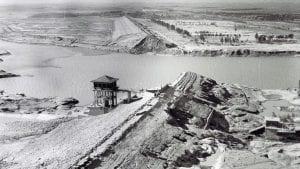
Banqiao Dam after the catastrophe
(Higginbottom, 2019)
This paper will examine three major topics. First, using Panarchy adaptive cycle as lens, to explain the making of this disastrous event, from innovation to conservation and from catastrophic release to reorganization (Gunderson & Holling, 2002). Secondly, identify the missing resilience factors that could have prevented this scale of disaster, by providing counterfactual scenarios to cross analysis (Gunderson & Holling, 2002). Finally, compare the Banqiao Dam catastrophe with modern day mega-project, the Three Gorges Dam, and analysis if it repeats the similar systemic flaws as the Banqiao Dam, under similar governance structure (Bao et al., 2015).
Analytical Framework — Panarchy
The Panarchy adaptive cycle lists traits for four phases in the cycle, innovation and growth/ r-phase, conservation and efficiency/ k-phase, release and destruction/ Ω-phase, and reorganization and renewal/ α-phase. There are different scales of cycle that are nested together, and can be extinguished by their size and timeline, for example, local at faster speed, regional at medium speed, and global at slower speed. Smaller-and-faster cycle and larger-and-slower cycle can influence each other through “revolt” and “remember”, to trigger change of phase in larger cycles, or provide stability to smaller cycles. Within each cycle, there are three common traps. Rigidity trap is created by systems with high potential, high connectedness, and low resilience. Poverty traps are created by systems with low potential, low connectedness, and low resilience. Hyper-efficiency trap is created when system is being optimized for single goal at cost of diversity (Gunderson & Holling, 2002). Inequality traps could be formed post-disaster when reorganization worsens gaps, when survivors with fewer resources are locked in the renewal phase (Dade et al., 2022).
Due to the complexity of how huge engineering works tightly alongside with social, economic, and ecological subsystems, the Banqiao dam disaster in China is an insightful example of how Panarchy framework applies to complex system. In this cycle. R-phase represents the growth and development of the Banqiao dam during 1950 to mid-1960s. K-phase represents when the dam reaches its maximum efficiency during late 1960s to 1975. Ω-phase represents the release and catastrophic failure of the dam at the year 1975. α-phase represents reorganization after the disaster around late 1970s. The collapse event would be the “revolt” that triggered the macro-scale of disaster when 61 additional dams were destroyed and can be considered a “remember” for other developments within the country. The example of Banqiao Dam also presents how different traps mentioned in the Panarchy framework amplified the loss of this disastrous event. Using the Panarchy framework highlights not only what happened but why the same pattern is showing up across the scale. This study will also extract the design and governance lessons that China and the rest of the world can learn from when approaching similar type of mega-project.
Root-Cause Analysis
The causes that led to the 1975 Banqiao Dam Catastrophe can be categorized into four sections, engineering and technical flaws, extreme rainfall due to climate change, governance and transparency gaps, and socio-political inequality. The following writing elaborates on each of the four categories.
When the dam was built, it was under a tight timeline set by the government in an attempt to advance the country in short period of time. Little time was allocated in tailoring the design from Soviet template to China’s own region. The 1-in-1,000-year standard ignores the regional climate and was eventually under-designed. Sediment within the dam is caused by another engineering flaw, allowing silt to uplift the water level to top of freeboard. (Turpin, 2008) Seepage defect was revealed in documentation released later, possibly due to lack of geotechnical study. The Banqiao dam’s concrete overflow section was stitched into the adjoining earth-fill embankment by a 65 meters long lateral key wall that keyed 15 meters into the clay core. Because concrete and compacted clay settle and shrink at different rates, a narrow gap gradually opened along this concrete-earth contact (Nie & Shen, 2014). Political decision formed operational rigidity, pushing the limit to maximize output, moving water level to 120 meter high without any buffer (Xu et al., 2008). The design template borrowed from Soviet also lack seismic consideration, design was not altered to fit the western China geography as it lacks such assessment (Jackson, 2012).
After the second landfall in Fujian, China on August 3rd, 1975, Typhoon Nina was captured by blocking ridge in northeast China. The two components in the nature system have reduced the forward motion of the storm to zero, resulting in massive rainfall in one focused area of upper Huai River basin, for 3 days from 6th August to 8th August in the year 1975. At the same time, a secondary tropical depression south of Yangtze created a low-level atmospheric river towards Henan, where the Banqiao Dam is located. This combination of events has triggered unprecedent intensity of rainfall, with 1650 millimeters of rainfall within 24 hours, more than Henan’s annual means (Yang et al., 2017). During the storm, communication was sparse and slow as no real-time radio telemeters existed. The operator had only fourteen manual rain gauges, data was collected once per day and relayed through telephone. The true real average was under sampled by 30-50 % in the daily reports, causing Banqiao’s staff to underestimate the storm, and kept five sluices closed to conserve water until the water has overtopped the dam’s crest (Yang et al., 2017).
Governance and transparency gaps also play an important role in the making of this disastrous event. At least three decision centers were active between 6th and 8th of August, leaving the operator without a single direction. The Ministry of Water Resources in Beijing, concerned mainly with protecting downstream county seats. While the Henan Revolutionary Committee together with county officials, determined to avoid flooding newly reclaimed farmland. Finally, the People’s Liberation Army engineering is responsible for last-resort demolition of auxiliary structures. On 6th August the dam’s operating staff telegraphed Beijing for permission to release water rapidly, the Ministry of Water Resources directed them to “keep the gates closed, as downstream areas are already inundated.” By the morning of 7th August, the provincial flood-control headquarters reversed the decision and instructed Banqiao to open all gates, to release overflow while the local People’s Liberation Army unit prepared explosive charges on two diversions. But the wire message never reached the control room as the telephone line failed due to the storm (Turpin, 2008). Daily rainfall, reservoir-stage, and discharge sheets were stamped “classified” under state-secrets regulations, only the reservoir bureau and the provincial flood-control headquarters saw the raw numbers. In 1956, the Banqiao dam’s height increased but no independent dam-safety audit was undertaken. After the collapse, all telegram transcripts and gauge records were sealed and shipped to archives, the disaster remained unreported in the public press or academic literatures until partial declassification after two decades. Due to the previous factors, exterior scrutiny from technical and public sector was impossible. Without the outside reviews, warning signs of seepage and blockage of gates never translated into repair budgets. Because of the secrecy of data, hard-learned lessons were not fed back to the national design codes and safety standards (Ma, 2025).
The cause that multiplied human toll after the collapse of the Banqiao dam was due to socio-political inequality and vulnerability. Due to the lopsided transport capacity, the urban residents were able to move to higher ground within hours of the disaster using automobile, while the rural families can only evacuate on foot or ox carts, as outside the cities, most production brigades owned no engine-powered vehicles, losing critical evacuation time (Xu et al., 2008). After the disaster, relief allocation was unevenly distributed. Rural areas experienced prolonged food shortage due to food being dispatched from warehouses to work-unit compounds. Famine among those areas along with malnutrition, increased human toll after the disastrous event (Dade et al., 2022).
Counterfactual Scenarios (Resilience Levers)
The 1975 Banqiao Dam collapse was not an inevitable consequence of an extreme storm. It was the culmination of specific design choices, management routines, and governance structures that foreclosed timely adaptation. By “re-running” the event virtually under four alternative operating regimes, it is possible to gauge just how much human and material loss was embedded in the rules rather than in nature. Each regime strengthens one or more of the resilience qualities, redundancy, tight feedback, decentralized decision-making, and diversity, identified earlier through the Panarchy lens.
Scenario A: Safety-first operations that adds redundancy and tight feedback (Gunderson & Holling, 2002). A safety-first regime would have begun with a structural doubling of discharge capacity. Adding a second gated spillway, complemented by a low-crest earthen fuse-plug, would have ensured that the 13,000 cubic meter per second peak calculated after Typhoon Nina could be spilled without overtopping the crest (Xu et al. 2008). Operating rules that automatically lowered the pool by three meters whenever twenty-four-hour quantitative-precipitation forecasts exceeded two hundred fifty millimeters would have restored the freeboard eroded by chronic siltation, converting meteorological information into actionable slack and embodying the tight-feedback principle emphasized by Gunderson and Holling. Finally, pressure-grouting and piezometer instrumentation along the concrete-earth junction, flagged in Nie and Shen’s forensic report as the most active seepage line, would have arrested internal erosion long before it reached a critical gradient (Nie and Shen 2014). Taken together, these measures would likely have allowed Banqiao to survive the storm, thereby preventing the cascade into the lower Huai basin and trimming the death toll to perhaps fewer than ten thousand.
Scenario B: Decentralized warning and evacuation that adds decentralization and diversity (Gunderson & Holling, 2002). The second pathway relocates authority, and therefore improve reaction time, from Beijing to the flood plain itself. Granting county magistrates statutory power to issue evacuation orders would have collapsed a decision chain that, in 1975, stretched across three competing command centers (Turpin 2008). A layered alert system combining electric sirens, short-wave broadcasts, and traditional drum relays, each backed by diesel generators, would have provided communication redundancy if the main grid failed, a weakness identified in post-event interviews with surviving operators (Ma, 2025). Releasing real-time rainfall and reservoir data to the public would have empowered households to self-evacuate rather than wait for contradictory telegrams. In Panarchy terms the change introduces diversity at the communication node and decentralizes decision-making, two levers that shorten response latency (Gunderson & Holling, 2002). If the breach had still occurred, the human exposure window would have narrowed from hours to minutes, plausibly reducing fatalities by two-thirds and shortening the famine tail reported by Dade and colleagues (Dade et al. 2022).
Scenario C: Layered Flood-Control Infrastructure that adds redundancy and diversity (Gunderson & Holling, 2002). A third scenario shifts attention from the dam to the catchments that feed it. Restoring the headwater wetlands drained during the Great Leap Forward would have re-instated a hydrologic sponge capable of shaving roughly fifteen percent off the incoming flood peak, according to extrapolations from comparable North-China basins (Bao et al. 2015). Mid-valley detention basins, excavated along natural floodways, would have supplied an intermediate storage tier, preventing synchronous cresting at Banqiao and its downstream siblings. Stepped ecological terraces positioned within the water-level-fluctuation zone would have added roughness and slope stability. These interventions embody both redundancy and diversity by spreading hydraulic load across multiple buffers operating at different spatial and temporal scales. Even if Banqiao had overtopped, the cascade probability would have fallen sharply; transport corridors could have reopened within weeks rather than months.
Scenario D: Iterative Governance Reform that adds tight feedback and decentralized oversight (Gunderson & Holling, 2002). The final pathway targets the rigidity trap embedded in the governance architecture. Introducing a five-year operating license, contingent on measurable safety indicators such as maximum allowable leakage and gate operability ratios, would have inserted a periodic disturbance that forces learning before the next historic rainfall cycle. Public hearings and the publication of independent audit reports, measures championed by Ma’s post-declassification study, would have broken the secrecy loop that insulated design flaws from external review (Ma, 2025). Establishing a citizen oversight board with representation from rural communes would have surfaced transport and relief inequalities documented by Xu et al. and Dade et al., thereby attacking the inequality trap at its root (Xu et al. 2008; Dade et al. 2022). In practice these reforms might have forced an early retrofit of the silt-blocked gates, financed fuel reserves for village trucks, and mandated equitable stockpiling of grain and medical supplies, greatly blunting both the physical and social aftermath.
Each pathway isolates a distinct failure vector, hydraulic overload, decision paralysis, structural brittleness, or social inequity, and aligns it with a complementary resilience lever. When implemented concurrently in an effective way, the regimes would have reduced deaths and economic loss by large magnitude and would have transformed the 1975 event from a systemic collapse into a controllable flooding, even if it is still severe. The adaptive-cycle lens thus clarifies not only the mechanisms of failure but the precise interventions capable of shifting trajectories toward persistence and renewal. The same logic now invites scrutiny of the Three Gorges complex: does its governance loop already implemented the necessary disturbance regimes, or is it silently reproducing Banqiao’s rigidity on a much larger stage? The answer will depend on whether the lessons distilled here move from archives and records into operation.
Comparative Case — Three Gorges Dam
The impounded storage behind the Three Gorges Dam now exceeds thirty-nine cubic kilometers, a volume of magnitude larger than that of the Banqiao dam. The potential inundation zone stretches the length of the Yangtze River’s middle and lower reaches and is home to more than four hundred million residents, approximately one Chinese citizen in every three (Bao et al., 2015). Within that corridor lies the Yangtze River Delta manufacturing cluster, which contributes more than fifteen percent of the national gross domestic product and anchors the country’s export economy (Qing et al., 2016). Any cascading failure emanating from Three Gorges would therefore constitute not merely a regional disaster but a systemic economic shock capable of reverberating through global supply chains.
Since the initial reservoir impoundment in June 2003, the region has recorded several reservoirs induced earthquakes of magnitude five or greater within a 50-kilometer radius of the dam axis (Bao et al., 2015). The most publicized geotechnical incident, the Badong landslide, involved an estimated 20 million cubic meters of sandstone that collapsed into the reservoir and generated an enclosed body of water felt nearly two hundred kilometers downstream (Bao et al., 2015). Jackson’s deterministic hazard model demonstrates that impoundment-related pore-pressure diffusion is capable of amplifying stress on pre-existing faults. He therefore recommends continuous deformation tracking with combined global positioning system and “interferometric synthetic-aperture-radar monitoring”, a program that has not yet been fully funded (Jackson, 2012).
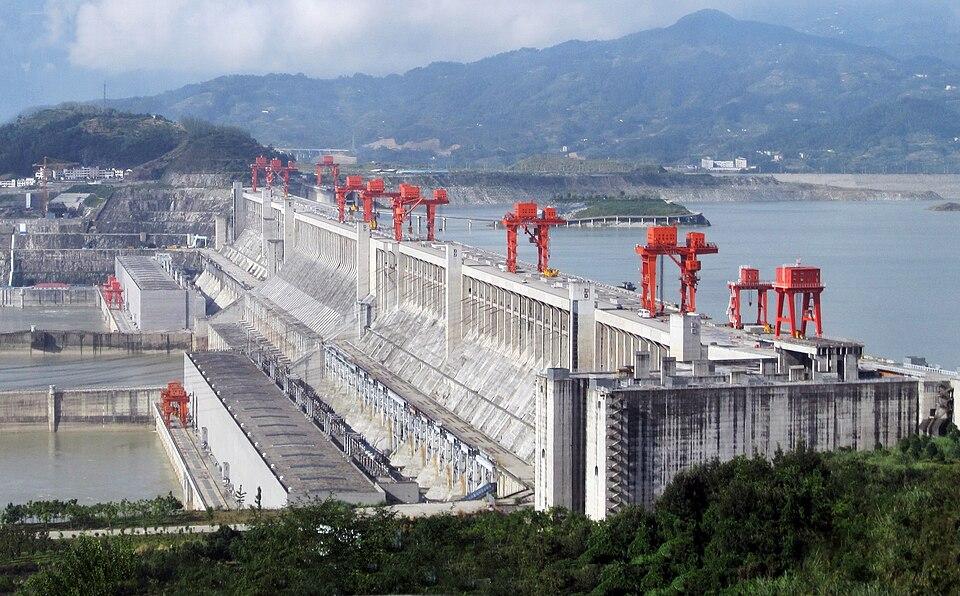
The Three Gorges Dam on the Yangtze River, China.
(anonymous, 2009)
Archival and secrecy continuity from in the Banqiao era remains striking. Safety-inspection files and real-time operating logs for Three Gorges are still classified as internal documents, and external researchers must apply for special permits to access the documents, which are frequently denied (Turpin, 2008). Civil-society critiques, most prominently Dai Qing’s edited volume The River Dragon Has Come! continue to document grievances over forced relocation, ecosystem fragmentation, and cultural-heritage loss (Qing et al., 2016). Although little signs of deliberative evolution are visible, a government piloted series of online hearings has invited public comments on reservoir release schedules, an experiment Ma describes as China’s tentative move toward an “environmental deliberative democracy” (Ma, 2025). Whether these signals mark the beginning of an α-phase reorganization or merely a smokescreen on an entrenched K-phase remains a critical research question.
Policy & Governance Recommendations
True transparency demands more than post-event reports. Hourly discharge, reservoir stage, and deformation data should be streamed to an open online based dashboard, complemented by crowd-sourced rainfall reports collected through smartphone-based gauges (Ma, 2025). Prior to any major release, dam authorities should convene hybrid hearings, both face-to-face and digital, to give downstream stakeholders real voice in operational timing. It is also worth noting that China is still enforcing a significant level of self-enclosure, creating a "national intranet” rather than a fully integrated part of the global internet. The great firewall will prevent all outside criticism from reaching and influencing its citizens, stifling innovation, limiting access to information and education for its citizens.
A legally independent Dam Safety Authority, financed through a dedicated levy on hydropower revenues, would insulate technical oversight from provincial fiscal pressures. Foreign peer-review missions, invited on a 5 to 10-year to cycle, would expose safety culture to the best global practice (Turpin, 2008). Parallel to that body, a national Seismic Oversight Board should apply Jackson’s fault-screening checklist to every proposed impoundment, vetoing projects that fail stress-transfer tests (Jackson, 2012).
Real-time deformation alarms can be triggered by machine-learning analysis of interferometric synthetic aperture radar images, cross-checked against global positioning system baselines, technology fully consistent with the tight feedback principle in Panarchy (Gunderson and Holling, 2002). Within the reservoir’s water level fluctuation zone, an annual geomorphic survey using Bao’s indicator suite, bank retreat rates, terrace-edge subsidence, and pioneer-vegetation colonization, should flag stress accumulation well before catastrophic release (Bao et al., 2015).
Social resilience must be funded in advance rather than improvised. A relocation insurance pool, capitalized in advance and administered on a public blockchain ledger, would guarantee that every household in the failure shadow receives timely compensation (Dade et al., 2022). A transparent grievance portal, with time stamped entries and public remediation tracking, would help close the inequality trap that magnified suffering after any disastrous event, like the Banqiao Dam Catastrophe.
Resilience Strategies via Panarchy
Physical diversity begins with multiple spillways augmented by earthen fuse-plugs, each calibrated to fail at a lower head than the main concrete structure, thereby eliminating the single-point-failure mode that doomed the Banqiao dam (Gunderson & Holling, 2002). Economic diversity downstream, blending aquaculture, eco-tourism, and dry-land agriculture, dampens the poverty-trap dynamic by reducing dependence on a single flood-plain monoculture (Dade et al., 2022), improving diversity and redundancy.
A nested command system, beginning with dam on-site engineers, passing through county emergency managers, and culminating in a basin-wide authority, allows any tier to halt risky operations, thereby severing cascade pathways (Gunderson & Holling, 2002). Deliberative “citizen panels” at the county level further distribute decision power and inject plural values into release scheduling (Ma, 2025), promoting modularity and decentralization.
A publicly accessible registry of near misses, each unplanned seepage spike or partial gate jam logged within twenty-four hours, would transform small failures into rich data for adaptive learning (Gunderson & Holling, 2002). After every shock, an inequality audit should map aid flows against demographic need to ensure that recovery investments do not entrench existing disparities (Dade et al., 2022), promoting tight feedback and learning.
Conclusion & Future Research
The Banqiao Dam Catastrophe demonstrates how a rigidity trap, compounded by post-disaster inequality, can propel an entire basin into an Ω-phase collapse. Current evidence suggests that the Three Gorges system is drifting toward a late-K condition under the twin pressures of hydrologic extremity and reservoir induced seismicity (Jackson, 2012; Bao et al., 2015). The counterfactual levers outlined above, redundancy, decentralization, diversity, and tight feedback, offer concrete routes to reset that trajectory before an irreversible release occurs.
First, the sector requires open-access “digital twins”: dynamic online based structural health models for every high hazard dam, editable by international researchers and regularly validated against field data (Ma, 2025). Second, the inequality-trap framework advanced by Dade and colleagues should be applied across a global sample of mega sized dams to test whether social-equity variables predict recovery speed (Dade et al., 2022). Third, Bao’s geomorphic early-warning protocol for the water-level-fluctuation zone ought to be standardized and extended to every impoundment on the Yangtze main stem (Bao et al., 2015). Together, these lines of inquiry can convert the Banqiao Dam Catastrophe’s hard lessons into a forward-looking science of resilient infrastructure.
References
Bao, Y., Gao, P., & He, X. (2015). The water-level fluctuation zone of Three Gorges Reservoir: A unique geomorphological unit. Earth-Science Reviews, 150, 14-24. https://doi.org/10.1016/j.earscirev.2015.07.005
Dade, M., Downing, A., Benessaiah, K., Falardeau, M., Lin, M., Rieb, J., & Rocha, J. (2022). Inequalities in the adaptive cycle: reorganizing after disasters in an unequal world. Ecology and Society, 27(4), 10. https://doi.org/10.5751/ES-13456-270410
Gunderson, L. H., Holling, C. S., & EBSCOhost. (2002). Panarchy: understanding transformations in human and natural systems. Island Press.
Higginbottom, Justin. (2019, February 18). Dam collapse that China kept secret. MCLC Resource Center. https://u.osu.edu/mclc/2019/02/18/dam-collapse-that-china-kept-secret/
Jackson, J. (2012). Earthquake Hazards and Large Dams in Western China: A Probe International Study. (73 pp.). https://journal.probeinternational.org/wp-content/uploads/2022/11/john-jackson-report-mar27.pdf
Ma, Z. (2025). Towards environmental deliberative democracy in China. Humanities & Social Sciences Communications, 12(1), 500-511. https://doi.org/10.1057/s41599-025-04837-5
Nie, B. S., & Shen, Z. Z. (2014). Study on the seepage defect at the connection of the Overflow Dam and the Earth Dam of Banqiao Reservoir. Advanced Materials Research, 1028, 287-291. https://doi.org/10.4028/www.scientific.net/amr.1028.287
Qing, D., Thibodeau, J. G., Williams, M. R., Dai, Q., Yi, M., & Topping, A. R. (2016). The river dragon has come!: Three gorges dam and the fate of China’s Yangtze River and its people. Routledge.
Turpin, T. (2008). Dam. Reaktion.
Xu, Y., Zhang, L., & Jia, J. (2008). Lessons from catastrophic dam failures in august 1975 in Zhumadian, China. GeoCongress 2008, 162-169. https://doi.org/10.1061/40971(310)20
Yang, L., Liu, M., Smith, J. A., & Tian, F. (2017). Typhoon Nina and the august 1975 flood over Central China. Journal of Hydrometeorology, 18(2), 451-472. https://doi.org/10.1175/jhm-d-16-0152.1
Zaleski, A. (2022). The fatal engineering flaw behind the deadliest accidental building collapse in U.S. history. In Popular mechanics (New York. 1959) (Number 6, p. 32). Hearst Magazines, a Division of the Hearst Corporation.
Zhang, Q., Lu, Q., Zhong, D., & Ye, X. (2018). The Pattern of Policy Change on Disaster Management in China: A Bibliometric Analysis of Policy Documents, 1949-2016. International Journal of Disaster Risk Science, 9(1), 55-73. https://doi.org/10.1007/s13753-018-0164-y
Zipper, M., Zulauf, N., & Bendels, M. H. K. (2020). The Banqiao Dam catastrophe. Zentralblatt für Arbeitsmedizin, Arbeitsschutz und Ergonomie, 70(5), 230-235. https://doi.org/10.1007/s40664-019-00382-6